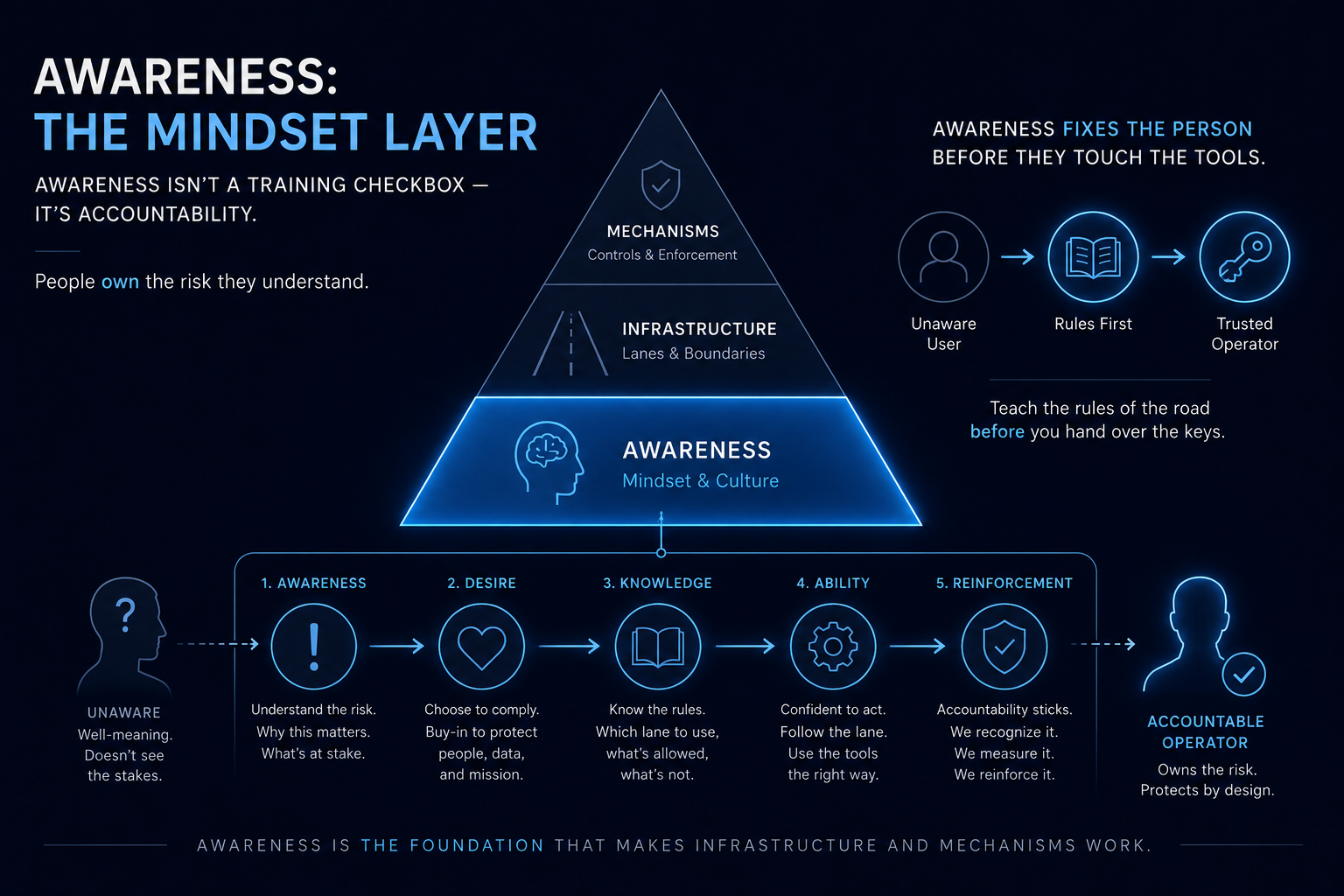
The Person Who Doesn't Know the Stakes
Right now, someone in your organization is connecting an AI agent to something that matters. They're doing it with the same mental model they'd use to install a browser extension — low stakes, my call, no harm done. They don't intend harm. They simply don't understand that this is different. That mental model is the single largest risk most organizations have, and no technical control catches it, because the person doesn't know they're taking a risk at all.
That is a change-management gap, not a discipline problem. And it is the layer nearly every AI governance program underfunds, because it isn't technical and it doesn't demo well. You can't screenshot a mindset.
But this is the foundation the other two layers sit on. Build the lanes and the mechanisms without building the mindset, and well-meaning people will route around excellent controls with the best of intentions — which is exactly how the database gets deleted. Awareness is the layer that gets the mindset right first. You teach people to drive before you hand them the keys.
"Awareness" Is the Wrong Word for It
The word sounds soft — like a training-completion checkbox, a module everyone clicks through. That framing is why the layer gets underinvested, and it's wrong. The target isn't awareness. It's accountability: an organization where every person who touches AI knows that bringing it into their work carries real risk, knows which lane their use belongs in, and owns the consequences of leaving it.
People own risk they understand. They don't own risk they were emailed. The distance between "we published the AI policy" and "people actually operate by it" is the entire problem — and closing that distance is not a communications task. It's change management, a discipline with decades of method behind it, and it's the discipline AI governance keeps skipping.
The mindset is the outcome. Change management is how you actually produce it.
The Mechanism: ADKAR, Mapped to AI Adoption
Here is what makes this a mechanism and not a poster. Prosci's ADKAR model breaks any individual change into five sequential outcomes a person must reach — Awareness, Desire, Knowledge, Ability, Reinforcement. It is not a motivational frame; it is diagnostic. When a change fails to stick, ADKAR tells you which stage broke, so you fix the actual gap instead of re-sending the policy and hoping.
Mapped onto AI adoption, the five stages become concrete governance moves — the operational content of the Awareness layer:
The person understands why connecting an AI agent is not like installing a browser extension. Not "AI is risky" in the abstract — the specific stakes: an agent wired to the wrong data or API can delete a business in seconds, or open a door an external actor walks through. This is the stage almost everyone skips, and it's the one the nine-second database deletion was caused by.
Understanding the risk isn't enough; the person has to want to use the lane instead of routing around it. That desire comes from the lane being genuinely faster and easier than the workaround — governance as an enabler, not a roadblock. If the sanctioned path is slower than a personal account, Desire fails, and no amount of policy fixes it. This is where governance design and change management meet.
The person can answer, in plain terms: which lane does my use belong in, and how do I get into it? Fast lane for low-stakes experimentation; a different lane, with a different mechanism, for regulated or sensitive data. Knowledge is knowing the rules of the road — what the lines mean, what each lane requires — before getting behind the wheel.
Knowing the rule and being able to follow it are different things. Ability is the demonstrated capability to work inside the lane's boundaries — to use the sanctioned tools, request lane entry, escalate correctly. This is where hands-on enablement replaces the training checkbox. A person who knows the lane exists but can't navigate it will improvise, and improvisation is where incidents live.
The mindset degrades without reinforcement. This stage is where Awareness connects to the rest of the framework: accountability persists because the lane's boundary is real, because crossing it produces an attributable event, and because the organization visibly uses its authority to say no. Reinforcement isn't a reminder email — it's the lived evidence that the rules have teeth. It feeds directly into Framework Health Monitoring, which measures whether people can still articulate their lane and whether the controls still trigger.
Why the Diagnosis Is the Point
The reason ADKAR is a mechanism and not a slogan: when AI adoption goes wrong, it almost always fails at one identifiable stage, and the fix for each is completely different.
| Symptom | Failed stage | The real fix (not "re-send the policy") |
|---|---|---|
| People connect agents casually, unaware it's different | Awareness | Make the specific stakes real and concrete, not abstract |
| They know the risk but use personal accounts anyway | Desire | Make the sanctioned lane faster than the workaround |
| They want to comply but don't know which lane fits | Knowledge | Clear lane definitions and a visible entry path |
| They know the lane but can't operate inside it | Ability | Hands-on enablement, not a completion checkbox |
| It worked, then drifted back to old habits | Reinforcement | Boundaries with teeth + health monitoring that catches drift |
Re-sending the policy is the default organizational response to every one of these symptoms, and it only ever addresses the Awareness stage — badly. A framework that can name the failed stage is the difference between fixing adoption and repeating the memo.
Proven at Scale
This isn't theory borrowed from a certification slide. I've run this discipline through large-scale enterprise adoption — including a 100,000-user platform adoption turnaround built on a structured change-agent network, where the work was precisely this: moving tens of thousands of people through the stages, diagnosing where adoption stalled, and fixing the stage that had actually broken rather than broadcasting louder. The tools were different; the mechanism was identical. Change management is how mindset gets produced at scale, and it is a repeatable engineering discipline, not a hope.
The Foundation the Rest Sits On
Awareness is the base of the pyramid for a reason. The Infrastructure layer gives people engineered lanes to move fast inside; the Mechanisms layer proves those controls are real. But both assume a workforce that understands the stakes, wants to stay in the lane, knows which one, can operate there, and is held to it. Take away that foundation and the lanes become boundaries people resent and evade, and the mechanisms become theater. Get the mindset right first, and everything above it holds.
Or you clean up after the nine-second deletion. Awareness is the choice between the two — made real by a discipline, not a document.
Together, they are AIM.